Women fighters of the 1871 Paris Commune

In the Paris Commune in 1871, for a brief but heroic few weeks, the working class took power for the first time in history. In the immortal words of Karl Marx, the masses ‘stormed heaven’. In extremely hazardous circumstances, Parisian workers attempted to re-organise society, to abolish exploitation and poverty, before falling beneath a vicious counter-revolution. CECILE RIMBOUD, Gauche Révolutionnaire (CWI France) outlines the key role that working-class women played in this historic struggle.

If the development of a society can be judged by the extent to which women are involved in it, that is certainly the case with a revolution. In 1871, women – especially women workers – played a huge role in the Paris Commune, despite significant hindrances. These heroic women workers swept aside forever the idea that their emancipation could happen outside of the class struggle.

Read more

Inside Sinn Féin

Now the biggest party in the North of Ireland, in the aftermath of the next general election in the South Sinn Féin – the party once synonymous with a paramilitary campaign – could be in power in both jurisdictions. With the spotlight increasingly on Sinn Féin, NIALL MULHOLLAND reviews a recent book promising a “groundbreaking telling of contemporary Ireland’s biggest and most elusive political story”.

The Long Game: Inside Sinn Féin

By Aoife Moore

Published by Sandycove/Penguin, 2023, £17.99

While true revelations are thin on the ground for anyone who has followed Sinn Féin’s trajectory, The Long Game does provide illuminating interviews with former and current members of the party, the IRA, and from the broader Irish republican movement. Although Sinn Féin refused to cooperate on the book, and most of those quoted do so anonymously, the Long Game often underscores the analysis of the republican movement made by the Committee for Workers International (CWI) over decades.

Read more

Women in revolt

Women in Revolt! Art and Activism in the UK 1970-1990

Showing at Tate Britain until 7 April. Entrance £17

Reviewed by Nancy Taaffe

The artwork displayed in the exhibition Women in Revolt! roughly starts at the end of the 1960s and beginning of the 1970s. In the post-war period the working class won big structural gains; the NHS, welfare, free education and council housing, as well as higher wages and improved working conditions. Reforms gave more money and more time to workers, men and women, two prerequisites for art.  

Read more

The real Lenin

This year’s centenary of Vladimir Lenin’s death has already inevitably seen the publication of books seeking to distort his political legacy. He and Leon Trotsky are still the two historical figures most hated and feared by the capitalist ruling class because it was their political understanding and party-building methods that ensured the overthrow of capitalism and landlordism in the 1917 Russian revolution. Here we are reprinting an abridged review by PETER TAAFFE of a biography of Lenin that first appeared in Socialism Today in issue No.93 July-August 2005, outlining the real relevance of Lenin’s ideas and practice for the struggle for socialism internationally.

Lenin

By Christopher Read

Published by Routledge, 2005

This book is not exactly in the same genre as recent ‘monumental’ histories by ‘modern’ historians like Richard Pipes or Orlando Figes, seeking to destroy the real lessons of the Russian revolution and of the great figures involved in what was the greatest social overturn in history. It is much more subtle but, in some ways, more deadly in distorting the real lessons of Lenin’s life, his role in the construction of the Bolshevik party and, as leader with Trotsky, of the October revolution.

The author at least appears to have examined Lenin’s collected works. The book is therefore full of many excellent quotes which explain Lenin’s ideas at each stage in his development and that of the working-class movement of Russia. But even when Read makes a correct point about Lenin’s ideas, it is usually quickly followed by a disclaimer. In general, he condemns Lenin with faint praise.

Read more

In defence of Marxist philosophy

Alongside our lead article on Lenin’s real political legacy, MARTIN POWELL-DAVIES examines his materialist philosophy, which has come under recent criticism by the prominent physicist and author Carlo Rovelli.

In 1909, the Russian revolutionary leader Vladimir Lenin published one of his less well-read works, Materialism and Empirio-Criticism. It was based on nine months of research he conducted in 1908 into the scientific and philosophical debates taking place amongst leading scientists of the time.

Lenin’s book took aim at the then fashionable philosophy of ‘Empirio-Criticism’. This was a way of thinking that had been set out by the Austrian physicist Ernst Mach and then adapted by Aleksandr Bogdanov, then a leading Bolshevik, under the label of ‘Empirio-Monism’. 

The development of quantum physics and Einstein’s theory of relativity meant that the debates being analysed by Lenin were soon overtaken by new scientific theories and evidence. The book’s contents are therefore often overlooked. However, Italian theoretical physicist and popular science writer, Carlo Rovelli, gave it unexpected publicity in his best-selling paperback Helgoland, published in 2020.

Read more

More hot air from another COP conference

‘Saying the right thing – and not a moment too soon’, was the headline of the editorial in The Guardian newspaper on the agreement of the final text of the UN sponsored COP28 summit in Dubai, this year’s latest round of global jamborees to discuss the (lack of) response to the looming climate crisis.

The ‘historic’ Paris agreement of COP25 committed national governments to aim to reduce the average increase in global temperatures to 2C above pre-industrial levels by cutting greenhouse gas emissions. This was tightened up at the COP26 summit in Glasgow in 2021, aiming for an upper limit of 1.5C which had been just an ‘aspiration’ at Paris. However, the mechanism discussed at those conferences to achieve these cuts was for governments to come up with their own ‘Nationally Determined Contributions’ (NDCs) to the target. These were voluntary and non-binding targets – and in the event, when they were released, even if fulfilled would cumulatively lead to global temperature increases reaching 3C.

Read more

Right-wing conspiracies and how to combat them

Naomi Klein identifies some of the economic and social factors that fertilise the ground for right-wing conspiracy theorists, but doesn’t explain how they can be overcome, argues CHRISTINE THOMAS.

Doppelganger: A Trip Into the Mirror World

By Naomi Klein

Published by Allen Lane, 2023, £25

Canadian writer Naomi Klein is best known for her anti-capitalist and climate crisis books, some of which have been reviewed in previous issues of Socialism Today. Her latest book, Doppelganger, is much more personal, inspired by the mainstream and social media world constantly confusing her with US writer Naomi Wolf. This wasn’t such a problem when, in the early 1990s, Wolf was “inspiring women to become feminists”. However, with the advent of the Covid pandemic, Wolf’s evolution took a disturbing turn for Klein, becoming a renowned peddler of Covid conspiracy theories.

Read more

Why Starmer’s New Labour is different to Blair’s

The Tories are in disarray and Sir Keir Starmer is heading for Downing Street within the next twelve months. But a New Labour Mark II government will not in any way be a mere repetition of the Tony Blair original, argues JAMES IVENS.

Launching Labour’s 2024 election campaign, Keir Starmer told voters in his New Year address: “hold on to the flickering hope in your heart that things can be better”. The tenor was that the Tories represent cronyism at the top and a cost-of-living crisis below, and Labour is not the Tories. 

Starmer’s Labour has ejected every pro-worker Jeremy Corbyn policy and the man himself. Yet public exhaustion with Conservative governments will still put Starmer in Number Ten. It did the same for Tony Blair in 1997. But far from pleading for ‘flickering hope’, Blair’s campaign was emphatic – his campaign theme song proclaiming, ‘things can only get better!’

Starmerism is Blairism in the epoch of capitalist decay. So what was Blairism? How did it pave the way for Starmer? What differences will its second incarnation have with its first?

Read more

The SWP and the Israel-Palestine conflict

How does a group like the Socialist Workers Party (SWP), describing itself as revolutionary socialist, end up rationalising the actions of an anti-working class organisation like Hamas? The answer lies in their decades-long failure to adopt a consistent class approach to national liberation struggles, argues JIM HORTON, making a contribution to the debate on the way out of the endless cycle of bloodshed in the Middle East.

The ferocious Israeli state terror currently being inflicted on the Palestinians in the Gaza Strip, where tens of thousands of civilians, including thousands of children, have been killed following the horrific attack by Hamas on Israeli civilians on 7 October, has brought into sharp focus the dangers of not adopting a class approach to the situation in the Middle East.

Last year, before the 7 October events, the Socialist Workers Party (SWP) published an updated edition of its 2014 pamphlet, Palestine: Resistance, Revolution and the Struggle for Freedom, saying it “goes beyond the headlines of the moment” and asking: “How can the Palestinians win justice and end the occupation for good?”.[i] The SWP’s approach, however, makes it incapable of answering that question.

Other than a call at the end for readers to join the SWP, there is no mention of the need for either workers, socialist or revolutionary parties to be established in the Middle East. Hamas though is referenced 38 times. This gives a hint of the non-socialist solution proposed, and the social forces the SWP believes can help with it.

Read more

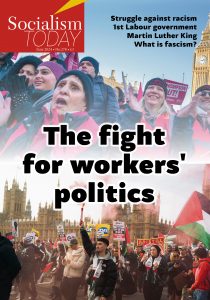
Editorial: New twists but a Starmer government still likely

Britain is in a pre-general election period, with the likely prospect of a Keir Starmer-led government coming to power within the next twelve months, if not earlier – the first Labour government since the ‘New Labour’ administrations of Tony Blair and Gordon Brown from 1997 to 2010.

However, even those whose memories go back to the 1974-79 Labour government cannot rely on past experience as preparation for what is coming. A hundred years after the very first Labour government, victorious at the election held in December 1923, a Starmer-led government could be the one that presides over a collapse in the party’s support similar to that suffered by the social democratic PASOK party in Greece or the Parti Socialiste in France. Both were comparable parties to Labour and were electorally annihilated as they implemented vicious austerity in government after the Great Recession of 2008-2009.

Potentially, therefore, the Tory party’s ongoing implosion could be put in the shade by the crises Labour will confront in office. A Starmer-led government will face huge economic and social upheavals, be rocked by mass struggles, and doing so with a shallow social base. This poses the question of what forces will step into the vacuum created by the further fracturing of the established parties in the next period, and whether the working class, as an organised force, can play the central role.

Read more