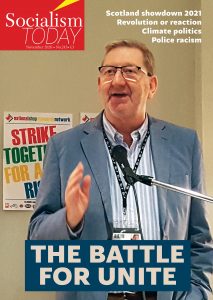
Vultures circle but Corbyn insurgency can still be saved

Re-grouping after the general election, the right renewed their destabilisation campaign against Jeremy Corbyn’s leadership. The following Socialism Today editorial was published in the September 2018 edition, issue No.221.

Jeremy Corbyn’s insurgent Labour Party leadership election campaign in the summer of 2015 raised the hopes and expectations of millions of workers and young people, not just in Britain but internationally.

The late Michael Meacher MP, one of the handful in the Parliamentary Labour Party (PLP) backing Corbyn, spoke at the time of “the biggest non-revolutionary upturning of the social order in modern British politics”. The enthusiasm for Corbyn’s anti-austerity challenge, he said, was a product of mass discontent with “20 years of swashbuckling capitalism”.

Read more

Warning lights flashing for Corbynism

The 2019 local elections saw Labour suffer a net loss of councillors. The editorial from the June 2019 edition of Socialism Today, issue No.229, was published just before the further warning sign of the 2019 European elections.

The promise of the Corbyn insurgency that began in 2015 is in danger. The triumph of the left-wing backbench outsider in the Labour leadership election four years ago opened up the prospect of overturning Tony Blair’s 1990s transmutation of the Labour Party into New Labour. By qualitatively changing Labour from a ‘capitalist workers’ party’ working-class political representation had effectively been eliminated as a mass force for over two decades. Jeremy Corbyn’s unexpected victory was a bridgehead from which, potentially, this process could be reversed and workers achieve a mass party of their own.

Read more

Brexit: no unity with capitalist politicians

By summer 2019 Theresa May had fallen, but the Labour right were blocking a no confidence motion in the new Johnson government. The following Socialism Today editorial was published in the October 2019 edition, No.232.

Have the September shenanigans in Westminster fatally undermined the chances of a Corbyn-led government being elected this autumn? And, as pertinently, what do they say about the character of such a government if it were to come to power in the midst of the political crisis and looming economic turbulence now confronting British capitalism?

Read more

Stand firm for socialist policies to stop Tory attacks

The 2019 general election was held on December 12. The following article is the text of the special supplement of The Socialist, issue 1067(1), produced as the results came in and printed and distributed on 13 December 2019.

The Tories have won a substantial parliamentary majority. Boris Johnson’s victory speech talked about being a ‘one-nation Conservative’ and promised increased spending on the NHS. This is a lie. When Maggie Thatcher won in 1979 she quoted Frances of Assisi, promising to bring harmony and hope to Britain.

Instead, she ruled ruthlessly and attacked the working class. Johnson will do the same and rule not for the ‘whole nation’ but the billionaires. His manifesto promised an immediate assault on the rights of rail workers to strike. This, combined with the recent brutal anti-democratic court rulings against the postal workers’ union, the CWU, gives a glimpse of the attacks on workers’ rights to come.

Read more

The special Covid crisis of British capitalism

Britain could well end up with the highest Covid death rate in Europe, fuelling the accumulating anger at the government’s handling of the crisis. While the union tops have largely vacated the field and Keir Starmer’s Labour leadership election was a victory for the capitalist establishment, that anger will find an outlet in a society being turned upside down by the crisis. HANNAH SELL writes.

On the surface Britain’s government did not seem the worst prepared for the corona pandemic. Prime minister Boris Johnson had led the Tories to election victory just three months earlier with the biggest parliamentary majority for the Conservative Party since 1987. In 2019 Britain had been found to be the second best prepared for a pandemic of 190 countries, beaten only by the US. As the pandemic has developed, however, while no government has taken the necessary measures to fully defend the working class from its effects, Britain has had one of the most ineffectual responses of the major capitalist powers.

Read more

Saboteurs at the heart of Labour’s apparatus

An internal Labour Party report, leaked to the British media over the Easter weekend in April, has detailed sabotage by senior party officials of the attempts by former Labour leader, Jeremy Corbyn, to radicalise Labour policies. It accuses senior party officials of working for Labour’s defeat in the 2017 general election.

The report, a mammoth 851 pages long, is entitled ‘The work of the Labour Party’s Governance and Legal Unit in relation to antisemitism, 2014-2019’. It quotes from transcripts of thousands of emails and WhatsApp discussions between Labour’s senior officials, particularly in the 2015-2018 era before the appointment of the current general secretary, Jennie Formby.

Read more

Beefing up the state

What role will the state play in the post-pandemic world? That question is posed by the economic measures, but also by the major powers granted in the new coronavirus laws.

Behind the ‘all in it together’ national unity line, capitalist governments world-wide are beefing up their powers to deal with the increased class struggle that is widely predicted. As IMF chief economist Gita Gopinath put it: “If the crisis is badly managed and it’s viewed as having been insufficient to help people, you could end up with social unrest”. There is no if about it.

Read more

New Labour’s real NHS legacy

Despite the heroic efforts of healthworkers the NHS has been ill-prepared to cope with the coronavirus pandemic. But the roots of this lie in years of neo-liberal policies, including the marketisation drive of the New Labour governments of Tony Blair and Gordon Brown, argues JON DALE.

Ten years of ConDem coalition and Tory austerity left the NHS ill-prepared for the sudden huge increase in very ill patients suffering from Covid-19. Over 100,000 unfilled staff posts (one in twelve), 17,000 fewer beds to their lowest level ever, equipment and personal protective equipment (PPE) stockpiles run down – these resulted from annual 1% funding increases when 4% was needed just to stand still.

Financial cuts were aggravated by years of upheaval following Tory Health Secretary Andrew Lansley’s Health and Social Care Act (2012). This caused such disruption to services that even his successor, Jeremy Hunt, was forced to row back on some of its measures. Lansley wanted NHS services provided by ‘any willing provider’ – private companies who would tender to win contracts. In a dire financial situation the lowest tenders were always likely to be picked, whatever the price in terms of quality. The drive towards privatisation has weakened NHS capacity to respond to Covid-19’s challenge.

Read more

The end of the Five Star episode

The most striking political development in Italy arising from the 2007-08 financial crash was the rise of the populist Five Star Movement, which emerged as the biggest single party with over ten million votes in 2018. But now the bubble has burst and, with anger rising as the coronavirus crisis ravages Italy, the task for the workers’ movement to build its own party is urgently posed. CHRISTINE THOMAS draws the lessons from the Five Star episode.

In the March 2018 general election, the Five Star Movement (M5S) secured a national vote of nearly 33%. In the ten years since comedian Beppe Grillo’s online followers began tentatively to stand candidates in elections, it went from a small, fringe protest group to become the most voted party in Italy, and one of the most successful populist parties internationally. Two years later, its support had fallen by more than 50%.

As the coronavirus crisis ravages Italy, M5S is in the governing coalition with the capitalist Democratic Party (PD), and various split offs from the PD. Even before the crisis, on 22 January, its then leader Luigi Di Maio resigned – the equivalent of a captain leaving a sinking vessel. Almost 30 MPs and senators had already jumped ship or been pushed overboard.

Read more

Global Warning: Even bankers see climate catastrophe ahead

Which firm bankrolls the destruction of the planet? JP Morgan Chase stands first in line, according to the Rainforest Action Network, which lists the US-based multinational investment bank as the premier financier of fossil fuels during the period 2016-2018. The Guardian asserts that JP Morgan provided $75bn in financial services to fracking and Arctic oil and gas exploration in that time.

Now, the bank has produced a report, Risky Business: the climate and the macroeconomy, (January 2020) which at first glance looks like a veritable conversion of Saint Paul on the Road to Damascus.

Read more