The reality of US ‘hard power’ exposed

Adding to the mounting difficulties for the Trump administration, in December the Washington Post published a six-part exposé of the US strategy in Afghanistan. The report was based on the so-called ‘Afghanistan papers’, an echo of the 1970s Pentagon Papers revealing the systematic official lying over US policy in Vietnam, whose release contributed to the fall of president Richard Nixon.

The Afghanistan papers are notes and transcripts from over 400 interviews conducted between 2014 and 2018 with people who have been involved in the Afghanistan conflict in varying capacities. The Post had to pursue a three-year court case to obtain the interviews – done by a US federal agency known as SIGAR (Special Inspector General for Afghanistan Reconstruction) – and is still fighting for full disclosure today, as some of the information was withheld.

Read more

Global Warning: Bad COP

‘Time for action’ read the subheading of the United Nation’s most recent climate change conference, known as COP25. Held in Madrid in December, it was the right call. Following record forest fires in California and the Amazon, and against the backdrop of bushfires raging across Australia, it appeared that, at last, the UN might mean business. That it would put the world’s governments on red alert and ensure decisive action is taken to halt the global warming caused by ever increasing emissions of greenhouse gases.

At the start of the annual gathering of representatives from 190 governments and dozens of agencies, NGOs and businesses, the UN issued a stark warning: greenhouse gas emissions had risen 4% since the Paris accord of 2015 and the world will need to cut them by 7.6% every year of the next decade to stay within the limits advised by climate scientists.

Read more

The system that ruins the world

To meet an ever-growing questioning of capitalism since the crisis of 2007-08, the system’s defenders look to theoretically justify its continued rule. The latest effort, by the renowned former World Bank economist Branko Milanović, which claims that capitalism is now unchallenged for the first time in history, is reviewed by PETER TAAFFE.

Capitalism, Alone: The Future of the System That Rules the World

By Branko Milanović

Published by Belknap Press, 2019, £23-95

Like the majority of capitalist economists, the author of this book hails what he proclaims is the ‘victory’ of capitalism over ‘socialism’ and ‘communism’. However, Branko Milanović goes further than his predecessors by seeking to argue that the only choice on offer for mankind now is between so-called ‘liberal capitalism’ exemplified by the US, Western Europe and most of the rest of the world, and what he describes as ‘political capitalism’, for which China and Vietnam are the authoritarian models.

Read more

The long decline of British capitalism

What We Have Lost: The Dismantling of Great Britain

By James Hamilton-Paterson

Published by Head of Zeus, 2019, £9-99

Reviewed by Niall Mulholland

Up to 1939, Britain was the world’s largest exporter of manufactured goods and of energy (coal). From 1939 to 1945, it produced around 125,000 aircraft and a huge number of ships, motor vehicles, armaments and textiles. After world war two, Britain was a pioneer in antibiotics, radar, the jet engine and the computer. In 1950, Britain recorded the highest percentage of the workforce in industrial jobs and 80 percent of the population were classified as “working class”. In the 1970s, trade union membership was at its highest levels and inequality at its lowest.

Yet, within a few decades, much of Britain’s major industries, such as ship-making, coal mining, car-making and steel, were gone or greatly diminished, throwing millions out of work and rupturing working-class communities.

Read more

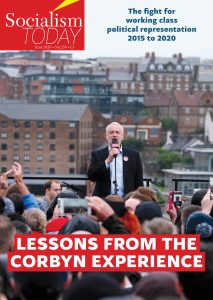
Editorial: How could Corbyn deliver?

“The only certain outcome of the general election”, argued the Socialism Today editorial published two weeks before the last contest (issue No.209, June 2017), “is that none of the contradictions besetting the political and social relations that sustain British capitalism” would be any nearer to resolution at the end of it.

“The crisis of capitalist political representation signalled by continuing Tory divisions”, we wrote then, “the uncertainties surrounding the Brexit negotiations; the battle around a new Scottish independence referendum… almost all the conceivable electoral scenarios will bring them into sharper relief”.

Two-and-a-half years later the underlying contradictions have only intensified and the political consequences are, if anything, even more unpredictable.

But, while there are a range of possible outcomes from the 12 December election, the most immediately important for the workers’ movement is the prospect of a Jeremy Corbyn-led government, with either a Labour parliamentary majority or in another ‘hung parliament’, and the consequent question: how could a prime minister Corbyn deliver the reforms he has promised the working class?

Read more

How radical are the Greens really?

The Green Party often present themselves as a radical alternative to the capitalist establishment parties. However, their actions repeatedly undermine that image. In this general election they have reached an agreement with the decidedly pro-establishment Liberal Democrats in order to promote remaining in the establishment’s EU club. This follows a record of voting for austerity measures when the party has held positions in local government.

Climate protests, including the worldwide youth strikes, have seen environmental issues rise rapidly in public consciousness. A YouGov poll earlier this year showed more than a quarter of people in Britain now consider the environment to be among the top three issues facing the country. This rises to 45% among 18-24 year olds.

Read more

Chile general strike rocks Piñera regime

Three million workers, youth and students, took to the streets throughout Chile on 12 November, in yet another mass protest and strike, sparked initially by a price hike in metro fares in the capital, Santiago, in October.

After nearly one month of protests and brutal state repression, this magnificent movement has refused to accept concession after concession by the regime of President Sebastián Piñera. Prior to the strike, Piñera undertook yet another u-turn and announced that the constitution would be revised and submitted to a referendum.

Read more

Global Warning: Still time to stop catastrophic climate change

A widely-reviewed recent book by David Wallace-Wells presents a grim picture of the future consequences of continuing global warming. But the real story of the future, argues JUDY BEISHON, is that socialist change can stop catastrophic climate change.

The Uninhabitable Earth – A story of the future

By David Wallace-Wells

Published by Penguin Random House, 2019, £9-99

David Wallace-Wells isn’t an environmentalist or scientist, but a New-York based journalist who has drawn from hundreds of sources to warn about the future impact of global warming on human lives. He made his book grim reading, opening with: “It is worse, much worse, than you think”. From there the message gets worse still, until about two-thirds of the way through he comments: “If you have made it this far you are a brave reader”.

Chapter after chapter hammers home the estimated environmental effects of each half point rise in planet temperature. The extent of heatwaves, floods, storms, deaths and migration. Already the planet has warmed by about 1.1 degrees celsius above the pre-industrial level and the effects so far are summarised, including that since 1980 there has been a 50-fold increase in dangerous heatwaves and a quadrupling of flooding. A study last year revealed that the melt rate of the Antarctic ice sheet has tripled in just a decade, indicating an increased pace of sea level rise.

Read more

Automated for the people?

A recent book by left-wing author Aaron Bastani is the latest to proclaim that new technology has the power to transform society, offering up fixes for global warming, poverty and much more. But how could such a change take place when the world economic and political system is in the hands of a rich, capitalist elite? HANNAH SELL writes.

Fully Automated Luxury Communism: a manifesto

By Aaron Bastani

Published by Verso, 2019, £16.99

Aaron Bastani is a Jeremy Corbyn supporter and one of the central figures in Novara Media, the left-wing social media platform. Fully Automated Luxury Communism outlines his vision for the future. Its publication is a symptom of the growing interest in socialist ideas. Unlike many anti-capitalist books it does not focus on the misery capitalism offers today but on the potential for new technology to lay the basis for a new society “as distinct from our own as that of the twentieth century to feudalism, or urban civilisation from the life of the hunter gatherer”.

Bastani lists the seemingly insurmountable problems of this society – including climate change and mass underemployment – and points to technological solutions. In a world where we are constantly told we have no choice but to accept the status quo his confidence in the possibility of change is refreshing.

Read more

A world in turmoil

A meeting of European sections and supporters of the Committee for a Workers’ International held in early November, which also included visitors from the USA and Nigeria, agreed a statement on the current world situation, an abridged version of which is printed below.  The full statement is available on the CWI website at https://www.socialistworld.net

The world situation is marked by explosive social upheavals and turmoil. The eruption of revolutionary and semi-revolutionary movements by the masses, especially the working class and youth, in Ecuador, Chile, Haiti, Catalonia, Hong Kong, and extremely significantly, Egypt, Iraq and the Lebanon, have features of the revolutions which swept Europe in 1848 and also some features of the stormy upheavals in 1917-18. These events have come hot on the heels of the renewed revolutionary upsurges which have previously shaken Algeria and Sudan.

Read more