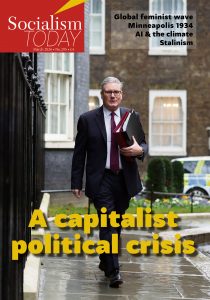
Yet again, Britain has a ‘dead prime minister walking’. Keir Starmer has survived his worst crisis yet, for now, but he is living on borrowed time. The next convulsion at the top of the Labour Party is possible at any point, perhaps triggered as soon as the result of the Gorton and Denton by-election. The capitalist media is full of discussion about Starmer’s weaknesses, the personal ambitions of the different contenders to replace him, and the undoubted scheming and manoeuvring for position on all sides.
None of this surface commentary, however, explains the root cause of the current crisis. Starmer is Britain’s fourth prime minister in four years. In the post-second world war period, prior to the 2007-08 financial crash, there was only one prime minister who was forced out of office in three years or less, the Tory Anthony Eden who resigned after the 1956 Suez Crisis. Since the financial crash and subsequent Great Recession, no prime minster governing on behalf of a single party has survived into a fourth year. Tony Blair, who stepped down as prime minister in June 2007, was the last to do so.
Gordon Brown lasted less than three years. David Cameron managed to survive his first term, serving at the head of a Tory-Liberal Democrat coalition government, but had to resign after the Brexit vote, just a year into the Tory-majority government elected in 2015. Since then, the tally has been Theresa May three years, Boris Johnson three years four months, Liz Truss 50 days, Rishi Sunak one year nine months.
This rapid turnover of prime ministers is not simply a product of the Tory party’s decrepitude. It flows from the crisis of British capitalism. Government after government has presided over stagnating living standards and continued austerity. Whereas from 1980 until the financial crash average real wages increased by 2.7% a year, the average since is an almost non-existent 0.1% a year. The social bases of the parties through which British capitalism has traditionally ruled were narrowing steeply before the Great Recession. Now that has sped up. Their support base is incredibly shallow, resulting in inherently fragile governments.
No doubt much of the capitalist class in Britain hoped that Starmer’s New Labour, with its 174-seat majority, and still wearing the tattered remnants of Labour’s past authority from when it was seen as the party of the working class, would be able to defend the interests of the capitalists more effectively than their disintegrating traditional party: the Tories. That was never on the cards, however. Labour’s 2024 election landslide was only possible because of the collapse of the Tory vote. Starmer was elected by 20.1% of the electorate, the lowest share for any incoming government since the introduction of universal male suffrage in 1918.
He came to power promising the working class very little, a government which would deliver “stability and moderation” and “tread more lightly on the lives of voters”. But inevitably even that has proved beyond Starmer’s government, which is riven by all the insoluble conflicting pressures faced by British capitalism as a declining power in a conflict-ridden multipolar world. Just as under previous Tory governments, the news continues to be dominated by an endless succession of government rows, crises and scandals.
Capitalists frustration with their government
Nor has he delivered what the capitalist class hoped for. The pages of The Economist and the Financial Times are full of articles bemoaning Labour’s failure to act decisively in the interests of the elites, and how Starmer’s weakened position will make that even more so. The Economist’s lead article on 14 February was typical. “Welfare reform will be off the table. So will any overhaul of education or the civil service that irritates the unions”. Above all, they conclude, the current “chronic instability means ignoring the public finances. Labour MPs are wont to declare that they ‘didn’t get into politics’ to impose cuts on their voters. A prime minister that clings onto power by handing out treats is not running a government but an ice cream van. Bond investors may lose patience”.
Britain’s national debt is now 101% of its gross domestic product (GDP) – the total value of all goods and services produced – and the cost of servicing this is at its highest share of GDP since the late 1980s. The capitalist class had no choice but to tolerate the increase in the national debt – first as a result of the bank bailouts in the Great Recession and then the huge state intervention during the Covid pandemic. Now, however, the majority want a government capable of cutting state expenditure further by attacking spending that benefits the working class. Starmer’s Labour – first with the scrapping of the winter fuel allowance and then the attack on disability benefits – has attempted to loyally do so, but has retreated as it plunged in the polls. Other measures the capitalists would like, such as breaking the pension triple-lock, they have as yet not even dared to touch.
Any capitalist government – regardless of its branding – will face the same quandary. For the capitalist class there is no way out of their profound crisis of political representation. Much as they wish it, they cannot conjure up a government with a strong social base that will reliably act in their interests. Labour’s attempts to do the bidding of the elites is destroying the very thin social base it had left.
With no clear way forward, there are inevitably growing divisions within the capitalist class on how best their interests can be defended. Nonetheless, Starmer’s current determination to defend his position is not merely driven by personal ego, but by what best suits the interests of the ruling class. So too with the decision to keep the Manchester mayor, Andy Burnham, out of parliament by blocking him standing for selection as the Labour candidate for the Gorton and Denton by-election.
Andy Burnham is no Jeremy Corbyn. He is part of the pro-capitalist New Labour project. He was a government minister under both Blair and Brown, and stood against Corbyn in the 2015 Labour leadership contest. Nonetheless, he has positioned himself to the left of Starmer, and if he was to become Labour prime minister he would be under huge pressure from below to at least introduce some reforms in the interests of the working class.
The big majority of the capitalist class are desperate to avoid risking that. They were burned by the Corbyn experience. Having conducted a ferocious struggle – to which Morgan McSweeney and Peter Mandelson were central – to reclaim Labour for capitalism, they do not want to risk a reversal. It is that, rather than just Starmer’s ego, which lies behind the eight-to-one vote on the Labour NEC sub-committee to block Burnham’s candidature in the by-election, and therefore his route back to parliament.
For now, Starmer is the best available of the bad options for British capitalism, which does not prevent The Economist dreaming of a “brave young reformist” emerging from the Parliamentary Labour Party. Nor does it exclude the capitalist class switching to someone who they hope could be such a figure as Starmer’s fortunes worsen even further.
Meanwhile Reform remains ahead in the opinion polls, and the tally of ex-Tory ministers that have joined it has hit eight. Clearly, the capitalist class, faced with the disintegration of the Tories and Labour, is starting to consider the possibility of a Reform government, and is working to try and ensure that it would reliably defend its interests. There is no question, of course, that a Reform government would defend capitalism. However, its right-populist character, winning votes by falsely posing as standing for the ‘ordinary man and woman’ against ‘the elites’, makes it inherently unreliable for the capitalists. A Reform government would also be certain to face mass working-class opposition. It is therefore not the preferred choice for the majority of the capitalist class.
Nonetheless, some are starting to wonder if a Reform government might have the brutality against the working class that they require. In the Sky News interview with the British billionaire Sir James Ratcliffe, widely reported for his racist comments, he also praised Nigel Farage, pointing to the need for a prime minister “who’s prepared to be unpopular for a period of time to get the big issues sorted out”. In addition to migration, the “nine million working-age people living on benefits”, were what he wanted ‘sorting out’.
If the working class enters the scene
The capitalists’ approach to their ongoing crisis of political representation is not fixed, particularly in this period of constant political flux, but will change under the impact of events. They currently face a terrain where parties doing their bidding are deeply unpopular with the majority of the working class, but our class still has no party that expresses its own independent interests. That changing would send shockwaves through the whole of society.
Imagine, for example, if Jeremy Corbyn and Zarah Sultana’s Your Party was on course to meet its initial potential. Imagine if even just a quarter of the 800,000 or so who initially showed support had become full members; that a campaign aimed at the base of the trade unions – and a democratic structure that put trade unions central – had led to the first unions affiliating; and that the initial surge in opinion polls was now being translated into the prospect of a victory in the Gorton and Denton by-election and winning a number of councils in May. All that was objectively possible, and would have seriously alarmed the capitalist class, while also increasing the confidence of millions of workers. In that situation it is not impossible that the capitalist class would have been willing to wear a Burnham-led Labour Party, in order to cut across a more dangerous alternative to its left.
Unfortunately, of course, that is not what we face. The mistakes made by the Your Party leadership mean it has not achieved even a faint echo of its objective potential. Given the absence of a mass workers’ party, some voters are turning to the Greens to express their anger with both Labour and Reform, but the electoral growth of the Greens is not a step towards independent working-class political representation, and therefore cannot have the same seismic effect on the political terrain.
Those Labour-affiliated trade unions whose leaders backed Andy Burnham becoming the by-election candidate need to draw conclusions from their failure to influence events within Labour. Andrea Egan, newly elected left general secretary of Unison, was the most prominent to criticise Burnham’s exclusion. But her criticism had no effect on the undemocratic behaviour of the Starmer machine.
In the Corbyn period there was no attempt to qualitatively reverse the destruction of Labour’s democratic structures that took place as part of Blair’s transformation of Labour into an unalloyed capitalist party. The affiliated trade unions have no meaningful ability to influence party decisions. And as leader Starmer has introduced further safeguards to prevent the possibility of a repeat of Corbynism. For example, unless Starmer resigns there can only be a leadership contest if at least 20% of the Parliamentary Labour Party back one candidate in advance of a contest.
Blocked by the NEC there has been no attempt by Burnham-backing trade union leaders, or by the man himself, to fight back. After all, Burnham could have taken the same path as Ken Livingstone, who stood and won as London mayor as an independent in 2000 when he was blocked from standing by Blair, saying it was necessary to uphold “the democratic rights of Londoners”. Instead, Burnham has just bowed down and expressed his ‘disappointment’.
For members of the affiliated trade unions, continuing to fund a party which represents the interests of their class opponents will be increasingly unacceptable. Sharon Graham, general secretary of Unite, was reflecting that pressure when she told the Financial Times on 12 February that “the mood music right now is to depart” from Labour. At this stage she is proposing to wait until the Unite conference in the summer of 2027 to discuss the issue, but there is growing pressure to enact the motions from two regions on the executive’s table to call a special conference this year rather than wait 16 months or so to act.
The issue that would be debated at such a conference, and increasingly throughout the trade union movement, would not just be whether to keep funding Labour but, more importantly, how the organised working class can start to build its own political voice. The capitalist class are clearly itching for new attacks on the working class. Coming on top of the decades of austerity already suffered, that is bound to face mass opposition. Our class creating its own party will be essential to increasing cohesion and fighting capacity for the battles that are clearly ahead.