Why did the Socialist Alliance break-down?
From Socialism Today No.79, November 2003
“Those on the left who have pinned their hopes on founding a new socialist party”, wrote the veteran Labour left-winger Tony Benn on the eve of Labour’s Bournemouth conference, “should note that the Socialist Alliance candidate only received 366 votes in Brent East and Arthur Scargill’s Socialist Labour Party (SLP) was only able to get 111 votes, which does not promise well for that strategy”. (Morning Star, 26 September 2003)
Read moreEditorial: How to save the planet

“When the leaders speak of peace”, wrote the German socialist artist Bertolt Brecht while living in exile in 1937, “the people know that war is coming”. Brecht’s pithy epigram, from his German War Primer poem, should be kept firmly in mind as the representatives of the countries that agreed the 1992 Rio Earth Summit United Nations Framework Convention on Climate Change gather this November in Glasgow for the twenty-sixth Conference of the Parties to the convention (COP26).
Almost half of the atmosphere’s extra, human-made carbon dioxide has been put there under the watch of these representatives in the period since, almost thirty years ago now, they solemnly signed the Rio convention to “prevent dangerous anthropogenic interference with the climate”.
Read moreThe battle for UNISON
Emerging from the Covid pandemic and following a decade of austerity, the capitalist class is once again determined to force the working class to pay the price for economic instability and crisis. But their success is not a foregone conclusion – that depends on whether there is a struggle.
In an attempt to stave that off, and particularly to prevent struggle finding a political expression, when Jeremy Corbyn won the leadership of the Labour Party in 2015 the Blairite right-wing embarked on a ferocious campaign. These representatives of capitalist interests in the Labour Party had spent years transforming it into a party safe for big business, and were not about to allow the door to open to the possibility of it becoming a vehicle through which workers could challenge the profit system.
Now with Corbynism defeated within the Labour Party framework the new battleground is in the biggest public sector trade union, with 1.3 million members, UNISON.
Read moreID divisions dangers are still there
The consultation on the 2004 Gender Recognition Act (GRA) launched by the Tory government in 2016 was not the starting gun for the ‘culture wars’ – but it did create a battlefield. The Tories faced a Labour opposition led by Jeremy Corbyn. They hoped making it easier for trans and non-binary people to self-identify would be a cheap way to cut across some of the hatred felt, especially among young people, for their nasty austerity party. Five years on, as we warned, the Tories admit they have no intention of improving the GRA. The battlefield, however, is still active.
Those pushing themselves to the front of the so-called debate arising from the GRA reform consultation falsely present women’s rights and the rights of trans and non-binary people as conflicting rights. They are not. All women and trans and non-binary people suffer in different and related ways because of the way capitalist society is organised and structured.
Read moreClimate talks: the hot air years
For nearly 30 years, capitalist politicians have talked about tackling global warming – since discussions held in the run-up to the Earth summit of 1992. But, as BEN ROBINSON shows in an article first published just before the 2015 Paris climate summit in Socialism Today No.194, they have done little to deal with this threat, bound as they are to the profit-driven system they represent.
The United Nations climate change conference in Paris is the latest in a series of talks that has gone on for 23 years. They have thoroughly demonstrated how bankrupt capitalism is, in the face of the coming climate catastrophe it has created. The rate at which pollutants are spilled out has continued to grow, virtually unabated by the discussions held by diplomats around the world.
Read moreIn the red forward line
Reading Len McCluskey’s autobiography will provide today’s activists with an invaluable insight into developments in the British labour movement during his term of office as the Unite union general secretary, argues PETER TAAFFE, and be an important preparation for future battles.
Always Red
By Len McCluskey
Published by OR Books, 2021, £16-99
Always Red by Len McCluskey, the recently retired general secretary of Unite, is a powerful and interesting autobiographical account of his life. It demonstrates the huge effect he has had on members of both Unite, the biggest trade union in Britain and Ireland, and the broader labour movement generally. It is vital for understanding the events in the British labour movement during his term of office. They encompass developments both in the trade unions and on the political terrain. His book is particularly relevant for helping to understand the tumultuous events in the Labour Party with the rise of Jeremy Corbyn to leader.
Read moreChristmas and the class struggle
Christmas is coming early this year for Socialism Today. Or is it? In examining the social roots of the mid-winter festival, NORMAN HALL shows that Christmas, and the different ways it has been celebrated, has always been very much a movable feast.
Readers of Socialism Today may view the coming mid-winter festivities with joyful anticipation or with a dismay born of poverty. But whatever your personal view or circumstances may be, it’s very difficult, if not impossible, to ignore Christmas.
To most socialists, it will come as a no surprise to find that Christmas is the continuation of very ancient traditions of mid-winter festivals. However, it may be a surprise to learn just how relatively new our Christmas is. In fact, there are serious arguments to say that this year marks only the two hundredth anniversary of Christmas and not the two thousandth or so.
Read moreEditorial: New openings for militant trade unionism
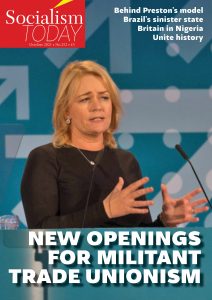
The victory of Sharon Graham as general secretary of Unite, amongst the biggest trade unions in the UK and Ireland and undoubtedly the most influential industrially and politically, has struck the labour movement as a thunderbolt. The Socialist Party and our sister parties in Scotland and Ireland supported Sharon and campaigned for her election. In the midst of the Covid crisis, this can be a pivotal moment for the trade union movement.
The roots for Sharon’s election are in the acute capitalist crises that have opened up that can be traced back to the Great Recession of 2007-08, the subsequent cuts barrage of Cameron and Osborne, and now the Covid pandemic. Workers have literally had to fight for their lives over the last 18 months but increasingly now have to struggle for their livelihoods as the bosses and their Tory government begin to go on the offensive.
Read moreThe sinister state of Bolsonaro’s Brazil
As support for president Jair Bolsonaro rapidly declines and he faces the prospect of defeat in the elections scheduled for 2022, CWI secretary TONY SAUNOIS reviews a compelling new book exposing the reality of capitalist democracy in Brazil.
Securing Democracy: My fight for press freedom and justice in Bolsonaro’s Brazil
By Glenn Greenwald
Published by Haymarket Boos, 2021, £19-99
It was the North American writer, Mark Twain, who declared, “truth is stranger than fiction. It has to be! Fiction has to be possible and truth doesn’t”. This assertion could possibly be apt for Glenn Greenwald’s gripping account of the dramatic events in Brazil prior to and during Bolsonaro’s ascent to the presidency. The book, while not a rounded out Marxist analysis, is a page turning read of amazing events, on occasions reading like a political espionage thriller. Yet it is a factual account with stunning revelations about the state, the media, the ruling class, and the reality of Brazilian capitalism. It confirms Glenn Greenwald as one of the most insightful investigative journalists of today.
Read more