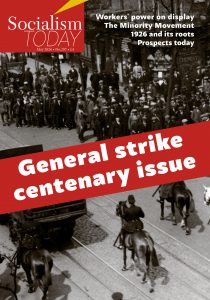
The 1926 general strike: working class power on display

This issue of Socialism Today is a special anniversary edition to mark the centenary of the 1926 general strike, the greatest movement to date in the history of the British working class. The opening overview article which follows below is from a major work by LYNN WALSH, written for the fiftieth anniversary of the strike in 1976 and first published in issue No.11 of the Militant International Review, our predecessor magazine, and reprinted here for the first time since.

General strikes are not accidental occurrences, simply the result of mistakes or misunderstandings between leaders. Nor can general strikes be brought about merely by small groups of political activists calling for general-strike action regardless of the time and conditions. A general strike inevitably arises from the open clash of class forces. Like all such clashes on a large scale, a general strike is inevitably rooted in the relationship of economic and political forces, and prepared and precipitated by events. This was certainly true of the 1926 strike, which flowed from the momentous struggles after 1918, marking a decisive turning point of the class struggles in the inter-war years.

“The whole of Europe is in a revolutionary mood”, the British prime minister David Lloyd George wrote to the Paris Peace Conference, meeting after the end of hostilities in the first world war. “The whole of the existing social, political and economic order is being called into question by the mass of the people”. Britain was no exception. Faced with revolts in India and Ireland, the British ruling class was also confronted by a radicalised working class at home. In 1919 there was an enormous upsurge of strikes (35 million days lost) as workers struggled for better conditions and to strengthen their organisations. In many areas, councils of action – soviets in all but name – sprang up to prevent British intervention against the October 1917 revolution in Russia.

Read more

Why did the Minority Movement fail?

The National Minority Movement, formed in 1924, involved at its height a quarter of the trade union membership and had experienced and authoritative class fighters as leaders. So why didn’t it shape the course of events in May 1926, asks PAULA MITCHELL?

“If the British proletariat had a leadership that came near to corresponding to its class strength and the ripeness of the conditions”, said Leon Trotsky speaking during the 1926 general strike, “power would pass out of the hands of the conservatives and into the hands of the proletariat within a few weeks. But such an outcome cannot be relied upon”.

In today’s volatile, crisis-ridden world, one thing unites all the sparring interests of capitalist powers and big businesses: the attempt to maintain profits and power on the backs of the working class. The only way forward to a secure, decent life for the vast majority of humanity is to break with capitalism and build a socialist society. Huge struggles lie ahead. Building working-class organisation and leadership is paramount.

In this hundredth anniversary year of the 1926 general strike – the closest the working class in Britain has come so far to revolutionary change, betrayed by the leaders of the Trades Union Congress (TUC) – the experience of the National Minority Movement (NMM) is rich in lessons for the struggle for organisation and leadership today.

Read more

The general strike today

The strike wave of 2022-2023, the biggest in Britain since before the shift in class relations that followed the collapse of Stalinism at the end of the 1980s, brought the question of the general strike back into political discourse. Reprinted below is an article by HANNAH SELL, first published in the September 2022 edition of Socialism Today, No.260, looking at the possibilities of general strike action in the modern era.

In Britain in 2017 just 33,000 workers took part in industrial action, the lowest level since records began in 1893. The numbers, at 39,000, were barely higher the following year. Against this background many on the left, including some who parted ways with the Socialist Party, turned away from the organised working class as the key force in the struggle to change society.

Read more

1926 and its roots

The General Strike 1926: A New History

By David Brandon

Published by Pen & Sword Books, 2023, £25

Reviewed by Harry Cooper

This book by David Brandon, a lecturer and author particularly of railway history, is an excellent and comprehensive history of the 1926 general strike. One of its major strengths is its focus on the economic context, and particularly the decline of Britain’s industrial power and the crisis in the coal industry, leading to a decisive showdown between capital and labour.

In this context, Brandon carefully reviews the failure of the trade union leadership, their cowardly role, and their fear of a major social upheaval challenging the capitalist order, which led the TUC to sell out the general strike.

Read more