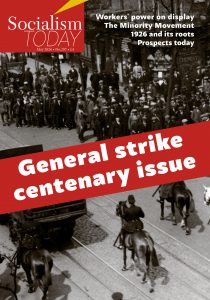
This issue of Socialism Today is a special anniversary edition to mark the centenary of the 1926 general strike, the greatest movement to date in the history of the British working class. The opening overview article which follows below is from a major work by LYNN WALSH, written for the fiftieth anniversary of the strike in 1976 and first published in issue No.11 of the Militant International Review, our predecessor magazine, and reprinted here for the first time since.
General strikes are not accidental occurrences, simply the result of mistakes or misunderstandings between leaders. Nor can general strikes be brought about merely by small groups of political activists calling for general-strike action regardless of the time and conditions. A general strike inevitably arises from the open clash of class forces. Like all such clashes on a large scale, a general strike is inevitably rooted in the relationship of economic and political forces, and prepared and precipitated by events. This was certainly true of the 1926 strike, which flowed from the momentous struggles after 1918, marking a decisive turning point of the class struggles in the inter-war years.
“The whole of Europe is in a revolutionary mood”, the British prime minister David Lloyd George wrote to the Paris Peace Conference, meeting after the end of hostilities in the first world war. “The whole of the existing social, political and economic order is being called into question by the mass of the people”. Britain was no exception. Faced with revolts in India and Ireland, the British ruling class was also confronted by a radicalised working class at home. In 1919 there was an enormous upsurge of strikes (35 million days lost) as workers struggled for better conditions and to strengthen their organisations. In many areas, councils of action – soviets in all but name – sprang up to prevent British intervention against the October 1917 revolution in Russia.
Read more