Editorial: How long can the Burnham bubble last?

In the event Andy Burnham scored a convincing victory in the Makerfield by-election in the Greater Manchester region of north west England on June 18, winning 24,927 votes, a 54.8% share, well ahead of the second-placed Reform UK candidate on 15,696 (34.5%).

It was a considerable turnaround. Just six weeks earlier Reform had swept the board in the May 7 local elections in the area, winning every seat available with an aggregate 50% of the vote across the constituency’s council wards, almost double the votes achieved then by Labour (26.7%). At that time too the Greens, fresh from their parliamentary by-election triumph in February in the Greater Manchester seat of Gorton & Denton which had seen off both Labour and Reform, polled over 3,000 votes (10.4%) in the Makerfield wards, to make them a viable contender. But on June 18 this had melted away to just 308 (0.7%). Makerfield really was Burnham’s ‘proof of concept’ victory – his argument that only he could hold back the prospect of a Reform government – which he was seeking when he decided to re-enter parliament to become eligible to stand for Labour leader and the premiership.

Read more

Reform social attitudes fallacy

“Support for Reform is much more than a protest vote, finds new British Social Attitudes research” is the title of the press release for the new BSA report ‘Who supports Reform?’, published in June this year.

The BSA report is based on a small subsection of responses to the annual British Social Attitudes survey conducted between August and October 2025. Overall, 18% of respondents to the survey were categorised as being ‘supporters’ of Reform. That categorisation was based on responses to a series of questions designed to “capture whether someone identifies with and has an emotional attachment to a particular party, even if currently they might not vote for that party”.

Read more

Global Warning: North Sea oil test for net zero politics

In the run up to June 18, eyes were turned towards the Makerfield by-election – transformed by Andy Burnham into a ‘referendum on Keir Starmer’s leadership’. Another by-election on the same day, in Aberdeen South, was dubbed by the Tories a ‘referendum on the oil and gas industry’. Reliant on North Sea oil for jobs and livelihoods, workers in Aberdeen and surrounding areas have suffered from ongoing job losses in the sector, as production starts to wind down. One study has estimated that 1,000 jobs a day are being lost, with some of these workers taking up employment in the renewable energy – often with worse pay and conditions, or finding fossil fuel jobs abroad.

Read more

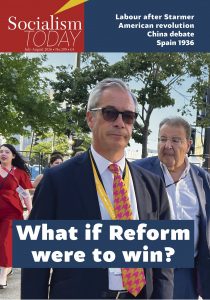
What would happen if Reform won?

HANNAH SELL reviews What if Reform Wins? by The Times journalist Peter Chappell, looking at how the capitalist class sees the prospect of a Reform government, and the tasks facing the workers’ movement.

What if Reform Wins? A Scenario

By Peter Chappell

Published by Bloomsbury, 2026, £16.99

Andy Burham’s victory over Reform in the Makerfield by-election, clearing the way to him becoming prime minister, has temporarily lessened the panic about the prospect of a Reform government. Surveys suggest that with Burnham at the helm, Labour would manage to overtake Reform in national opinion polls. For a little while at least; because, however much Labour MPs tell each other that they must not make the same mistakes as the Tories before them, their party is inexorably on the same path. Both parties are being destroyed as a result of ruling in the interests of decrepit British capitalism.

Read more

America’s revolutionary legacy

With up to nine million protesters on the streets in March protesting against Trump under the No Kings banner – more than the US population at the time of the nation’s founding war of liberation against the British monarchy – CHRISTINE THOMAS takes a timely look at America’s struggle for independence.

In his history of the Russian revolution Leon Trotsky wrote that one of the main characteristics of a revolution is the entrance of the masses onto the scene of history. In this respect, the struggle for independence from British imperialism by the 13 colonies that were to eventually constitute the United States of America was indeed a revolution.

Read more

Spain 1936: A crisis of leadership

This month marks ninety years since the working class and peasants of Spain rose up against General Francisco Franco’s fascist forces and capitalist exploitation in general. ADAM POWELL-DAVIES draws out the lessons of that heroic struggle for the situation facing Marxists today.

World events in 2026 confirm that capitalism today is in a new era of turmoil. Life for billions is increasingly marked by war, falling living standards, environmental breakdown, and attacks on democratic rights. On the other side of the coin, there is the heightened outbreak of new mass uprisings and revolutionary movements across the world, which in recent years have shaken all continents.

To find such an equivalent level of global volatility and polarisation it is necessary to go back to the two decades between the first and second world wars. This was a period of revolution and counter-revolution, in many ways epitomised in the major class battles which erupted in Spain throughout the 1930s.

Read more

The China discussion today

In 2007 Socialism Today began a series of articles under the heading, ‘The China debate’, to discuss the complex character of the state and the economy in a society encompassing one-sixth of all humanity. Nearly 20 years later, with developments both within China and in its geopolitical role still a source of contention in the wider working-class movement, we are relaunching the series, starting with this contribution by PHILIP STOTT on China and the Marxist theory of the state.

“Sociological problems would certainly be simpler, if social phenomena had always a finished character”, wrote Leon Trotsky in The Revolution Betrayed: What Is The Soviet Union And Where Is It Going? “There is nothing more dangerous, however, than to throw out of reality, for the sake of logical completeness, elements which today violate your scheme and tomorrow may wholly overturn it… The scientific task, as well as the political, is not to give a finished definition to an unfinished process, but to follow all its stages, separate its progressive from its reactionary tendencies, expose their mutual relations, foresee possible variants of development, and find in this foresight a basis for action”. 

Read more