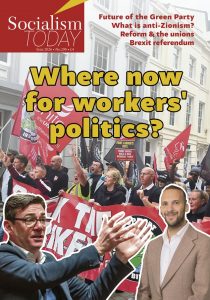
May’s seismic elections and the fight for workers’ politics now

The revolutionary events that convulsed Spain from the proclamation of the Second Republic in 1931 until the surrender of the Republican government to the fascist general Francisco Franco in 1939, began with the seemingly insignificant municipal elections of April 1931.

The sweeping victories for Republican supporters in the local government polls on April 12, however, were so stark in revealing the rottenness and shallow social base of the prevailing feudal-monarchical regime that the King, Alfonso XIII, fled into exile just two days later. This set off a chain of events – including the Spanish civil war, the start of which in July 1936 we will commemorate in the next edition of Socialism Today – during which the working class had not one but many opportunities to take power and begin the socialist transformation of society were it not for the role of the leadership of its mass organisations, trade unions and workers’ parties alike.

Britain’s various polls on May 7, for the Scottish Parliament, the Welsh Senedd and nearly 5,000 councillors in England which together covered almost two-thirds of the electorate, will not have the same immediate auspicious impact. But they most certainly were a qualitative tipping point in the disintegration of the old methods by which the capitalist class in Britain has maintained its political rule since the achievement of universal (male) suffrage in 1918 and the emergence of the Labour Party as a mass working-class party, particularly in the long post-world war two era, through an alternating duopoly of Labour and Tory-led governments.

Read more

How will the Greens develop now?

In the wake of the May elections in England and Wales, HANNAH SELL assesses the significance of the Greens’ ballot box surge and their claims to be a ‘workers’ party’.

The May 2026 elections were a turning point in Britain. The votes of both Labour and the Tory party collapsed; ending the duopoly via which capitalism has ruled for the best part of a century. The right-wing populists of Reform surged, and so did the Greens. Under their new ‘eco-populist’ leader, Zack Polanski, the Greens won an average of 17% of the vote across English local authorities, resulting in 441 extra councillors and winning control of five new councils. In Wales the Green vote share was a more modest 8% because Plaid Cymru were seen by most voters as the more effective way to protest against Labour and block Reform. Nonetheless, in these elections the Greens were the main left alternative to the establishment parties and to Reform. Meanwhile, Green Party membership has soared to 230,000.

Read more

Behind the Greens’ debate on anti-Zionism                              

A debate has broken out recently in the Green Party in Britain over what constitutes ‘anti-Zionism’. In a contribution to the discussion JUDY BEISHON explains the need to take a class approach to this issue, which has a relevance well beyond the Greens.

The horrific war against the Palestinians in Gaza, along with ongoing ethnic cleansing in the West Bank and brutal onslaughts on Lebanon and elsewhere in the region, has led to widespread condemnation of the ultra-right Israeli government by ordinary people worldwide.

Trying to counter the expressions of mass opposition and anger, many states have stepped up repression against anti-war protesters. Also, allegations of antisemitism, including equating anti-Zionism with antisemitism, have been widely used as a political weapon by the political right against the left, to try to undermine the left and weaken opposition to the Israeli state’s massacres, repression and wars.

Read more

The socialist approach to the EU

Ten years on from the referendum on the UK’s membership of the European Union, and with Brexit now an issue in both the unofficial Labour leadership race and in the debate on the character of the Greens, we reprint an article by CLIVE HEEMSKERK, first published in Socialism Today No.201, September 2016, under the title, Corbyn’s Brexit Opportunity. Written during that year’s challenge to Jeremy Corbyn’s leadership by the pro-remain MP Owen Smith, it argues the case for a socialist approach to the EU.

The main forces of British and international capitalism did everything they could to secure a vote in the June 2016 referendum to keep Britain in the EU. US President Obama made a carefully choreographed state visit. The IMF co-ordinated the release of doom-laden reports with the chancellor George Osborne. And then there was the shameful joint campaigning of right-wing Labour Party and trade union leaders with the Tory prime minister of the time David Cameron and other representatives of big business. A propaganda tsunami of fear was unleashed to try and intimidate the working class to vote in favour of the EU bosses’ club.

Read more