The revolutionary events that convulsed Spain from the proclamation of the Second Republic in 1931 until the surrender of the Republican government to the fascist general Francisco Franco in 1939, began with the seemingly insignificant municipal elections of April 1931.
The sweeping victories for Republican supporters in the local government polls on April 12, however, were so stark in revealing the rottenness and shallow social base of the prevailing feudal-monarchical regime that the King, Alfonso XIII, fled into exile just two days later. This set off a chain of events – including the Spanish civil war, the start of which in July 1936 we will commemorate in the next edition of Socialism Today – during which the working class had not one but many opportunities to take power and begin the socialist transformation of society were it not for the role of the leadership of its mass organisations, trade unions and workers’ parties alike.
Britain’s various polls on May 7, for the Scottish Parliament, the Welsh Senedd and nearly 5,000 councillors in England which together covered almost two-thirds of the electorate, will not have the same immediate auspicious impact. But they most certainly were a qualitative tipping point in the disintegration of the old methods by which the capitalist class in Britain has maintained its political rule since the achievement of universal (male) suffrage in 1918 and the emergence of the Labour Party as a mass working-class party, particularly in the long post-world war two era, through an alternating duopoly of Labour and Tory-led governments.
While keeping things in proportion, the May elections too revealed the rottenness and shallow social base of Britain’s old established political order, and open up a new period of flux and instability.
No more ‘two-party politics’
Just two years on from the 2024 general election, which resulted in an artificial, inflated parliamentary landslide but resting on the support of the lowest-ever share of the total electorate for a governing party, Sir Keir Starmer’s Labour has suffered a crushing defeat in a wave of visceral hostility. For the first time since 1922 Labour has failed to top a national election in Wales, with its absolute vote collapsing from 443,047 (in the constituency seats) in the previous contest in 2021, to 139,203, securing just nine Senedd members. In Scotland, Labour shed over a quarter of its 2021 vote in both the constituency and regional ballots, and has now got just 17 Members of the Scottish Parliament (MSPs) – tied with Reform – in a fifth consecutive fall since the first Scottish Parliament election in 1999. In England Labour lost 1,498 councillor seats out of the 2,557 it was defending – an attrition rate of 58% – and the majority control of 38 councils. It recorded its lowest-ever BBC ‘projected national vote share’ (estimated as if the whole country had been able to vote) of just 17%.
On this particular metric, in fact, the Tories actually increased their share from 15% in last year’s local elections to also score a projected national vote of 17% this time. That masked the reality, however, that there was no recovery for what has been the oldest and, until now, most successful political party in the world. In Wales the Tories’ support halved, from 289,802 constituency votes in 2021 to 134,926 with just seven Senedd seats, while in Scotland it was even worse. In 2021 the Tories had polled 637,131 votes for the regional list seats but this time it was 271,550, bringing their number of MSPs down from 31 to twelve. In the English locals, starting from an already low base – the Tories had won their lowest-ever number of councillors in London when these elections were last fought in 2022, for example – they still lost 563 seats, nearly 50% of those that they had previously held. In the one local authority they gained from Labour, the London borough of Westminster, the Tories’ support fell by five points on its 2022 score but with Labour’s falling by even more – as the Greens polled 17% but failed to win a seat – control of the council changed hands.
Between them Labour and the Conservatives achieved just 34% of the projected national vote share, the lowest ever combined score. Both were behind Reform, on 26%, and the Greens (18%), and only marginally ahead of the Liberal Democrats with 16%. This follows the historic low recorded in the combined vote of Labour and the Tories in the July 2024 general election, at 57.4%.
And the rejection of the old order duopoly was a more active protest amongst some layers this time, looking to elections as a means to strike back at ‘those up there’, including for many first-time Reform voters. It was not just a repeat of the angry but ultimately passive abstentionism that marked the growing alienation from the capitalist establishment parties under the Tony Blair governments.
Between 1997 and 2005 Blair’s ‘New Labour’, having been transformed from a working class-based party into a version of the capitalist US Democratic Party – effectively politically disenfranchising the working class and those sections of the middle classes hit by capitalist crisis – lost nearly four million voters as turnout fell to near US levels in the general elections of 2001 and 2005, Blair’s last alleged ‘popular triumph’. In May this year, however, turnout rose in many English council contests. And in Wales it was the highest ever for a Welsh devolved election (albeit still barely 52%), in which Plaid Cymru, Reform and, although less than in England, the Greens, were the beneficiaries. The exception was Scotland, where Reform also broke through and the Greens secured their best-ever result, but where overall turnout fell below the historic average, as the Scottish National Party (SNP) after 19 years in office joined Labour and the Tories in shedding votes as an establishment party while still returning to government in Holyrood.
But power relations have fundamentally changed after May 7 from before; including from when earlier this year Starmer issued a confidential directive to his cabinet, recently leaked, to not be “overly deferential” to Holyrood and the Senedd in pushing through the government’s agenda. And they have changed not only in dealings with the devolved administrations but in his ability, as a ‘dead prime minister walking’, to run a government capable of pushing through any serious measures in pursuit of the interests of British capitalism.
Uncharted territory
The strategists of the ruling capitalist class look on with a foreboding apprehension at the prospect of managing their system in the new, uncharted terrain of seven-party politics – at least – in Britain’s various tiers of government (and not including the position in Northern Ireland, with Assembly elections there due in 2027). How can they secure the necessary social base to push through what’s needed to attempt to deal with the dire situation that British capitalism faces?
The International Monetary Fund (IMF), in its annual ‘health check’ report on the UK economy released after the election results came in, baldly spelt out the capitalists’ requirements. The government must “stay the course” with the commitment by the chancellor Rachel Reeves to reduce government borrowing through tax increases on the working class and public spending cuts, the IMF’s mission chief to the UK urged. The government debt-to-GDP ratio of 95% (a £2.9 trillion market in UK government debt) and the plan to issue £250 billion of gilts this year in a volatile world capitalist economy, are the “structural realities” that “define the limits of policy choices” – whichever capitalist politician is prime minister.
What some of these ‘policy choices’ mean more concretely was revealed in a report in April from the Tony Blair Institute thinktank calling for the end of the ‘triple lock’ on state pensions, which sees pension payments rise each year by whichever is the highest of inflation, average wage growth or 2.5%. The Economist magazine, pointing out that public spending in Britain will reach 45% of GDP this year from 39% before the Covid pandemic – a £150 billion-plus gap – laments that such “big stuff”, including the social care crisis, shifting from welfare to warfare spending, trade relations with the EU etc, which have not been addressed by the Starmer government despite its huge parliamentary majority, will not be confronted now by a prime minister lacking “authority and clarity”.
“The promise of a leadership contest” after the May elections, it now plaintively hopes, switching from its previously broadly-supportive stance towards Starmer as prime minister, “is that it will draw out candidates who best meet that test” (16 May).
The New Labour paradox
A major problem that the ruling class face in finding a social base from which to implement their agenda however is that they no longer have a party rooted in the working class that they can call upon to carry it through. This historically was the role of the Labour Party when it was a ‘capitalist workers party’; that is, a party with the dual character of having a socialistic ideological foundation and a structure through which workers and their trade union organisations could move to fight for their interests, but at the same time with a leadership that reflected and fought for the requirements of capitalism.
Because of this dynamic – even as it contained within it an inherently explosive contradiction as all mass workers’ organisations do – Labour could be tolerated in office by the capitalists as a means of holding the working class in check by appealing to their loyalty to ‘their’ party, while being simultaneously undermined and eventually brought down by the capitalists’ pressure, or outright sabotage, when it could no longer perform that task. The problem with Starmer’s party, after the political and organisational transformation of the Labour Party under Tony Blair into the thoroughly capitalist New Labour – and the avoidable failure of Jeremy Corbyn’s leadership to reverse this – is not the minutely-vetted ‘socialism free’ commitment of its MPs to defend capitalism but the fact that the majority of the working class doesn’t see ‘Labour’ as their party anymore and has no loyalty to it to appeal to.
So is it really possible, without reversing the fundamental changes to the character of the Labour Party that have benefitted capitalism for a whole historical era, to use the Labour ‘brand’ to one more time carry out the capitalists’ demands?
Jeremy Burnham or Andy Starmer?
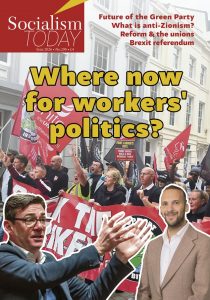
That’s the context in which to appraise Andy Burnham’s all-but-official run for the Labour leadership, beginning with his attempt to re-enter parliament and thus become eligible to stand for leader and trigger a contest, in the by-election in Makerfield in north west England on June 18.
The additional safeguards in Labour’s rules introduced by Starmer against a repeat of Jeremy Corbyn’s ‘accidental’ victory as Labour leader in 2015 – in which Burnham was one of the three Anyone But Corbyn ‘ABC’ candidates – included raising the threshold for the number of MP nominations needed to be a candidate to 20% (81) of the Parliamentary Labour Party (PLP). It is impossible for the remnants of the Socialist Campaign Group still in parliament, with just 24 MPs, to field a candidate. Burnham has stepped into the gap.
In 2015, for what was his second attempt at the leadership – he had also stood in 2010 when, in the preferential ballot used he voted for the Campaign Group candidate Diane Abbott last behind the arch right-wingers David Miliband and Ed Balls – Burnham chose the City HQ of the multinational Ernst & Young financial services firm to launch his campaign, saying that he might back further benefit cuts after abstaining on rather than opposing the then Tory government’s austerity-driving Welfare Reform and Work Bill. The close involvement in his campaign this time of Josh Simons, the MP who stood down in Makerfield to enable Burnham to stand and who was previously the director of the Labour Together thinktank that organised to purge ‘Corbynism’ from the party (succeeding Morgan McSweeney who left to become Starmer’s chief of staff), is another indication of how ‘safe’ for capitalism Burnham really is.
But nevertheless all kinds of metamorphoses are possible under extreme social pressures, for individuals and organisations, as Hannah Sell’s article in this issue discussing the character of the Green Party further examines. It was not, after all, the personality of Corbyn or the content of the actual programme he presented during his leadership that the capitalists feared. An Institute for Fiscal Studies analysis of Labour’s 2019 public ownership manifesto commitments, for example, estimated that they would have led to a change in control of just 5% of the total UK assets held by private companies. That was certainly more than enough to irritate the capitalists – while still leaving them with decisive control of the commanding heights of the economy which they would have undoubtedly used to sabotage a Corbyn-led government.
But the capitalists’ main fear was of the hopes and expectations that would have been unleashed amongst the working class, with its appetite whetted, if Corbyn had come into office. That will also be their fear from Burnham’s talk of bringing essential services under greater public control (even if he does not use the word, nationalisation), of ‘reprioritising’ spending towards council house building, and even “the end of neo-liberalism”, which he spoke of in his campaign video launch. But still, if the situation required it, even a Corbyn-led government would have had to have been managed with until the conditions were ripe to bring it down.
Andy Burnham is not Jeremy Corbyn but circumstances are forcing him not to be Keir Starmer too, not least the requirement to present himself as an insurgent to win the Makerfield by-election. On May 7 Reform candidates won every seat up for election on Wigan council in the Makerfield parliamentary constituency, polling just over 50% of the vote. Not only did Labour’s absolute vote fall in every ward, dramatically compared to their results in the last local elections in Wigan in 2024, but turnout rose, by never less than ten percent, as angry voters came out to punish the government.
Burnham has been compelled to pitch his Makerfield candidacy as “a vote to change Labour” – to change “this party back to the party people here used to know, the party that is solidly on the side of working-class community” – and to argue that Britain has been “on the wrong path for 40 years”, just to get a hearing.
A cold transition?
If Burnham wins decisively in Makerfield – a ‘proof of concept’ that only he could hold back the prospect of a Reform government – a cold, ‘orderly’ transition to the leadership is possible, with Starmer standing aside and no other challenger coming forward to prevent a coronation of the ‘King of the North’. In the same way Gordon Brown was able to succeed Tony Blair in 2007 when the Socialist Campaign Group MP John McDonnell was unable to secure enough MP nominations to stand.
But that didn’t end the ‘Blairite’ and ‘Brownite’ tensions within the PLP, a clash between different capitalist politicians, especially as the 2007-2008 world financial crisis broke. This time too, in an even more fraught geo-political and economic context for British capitalism, with no way forward, the divisions in the PLP that the May 7 debacle have brought to the surface – with The Economist describing “panicky Labour MPs” having “become a rabble” – will not be easily assuaged.
That will certainly be the case, of course, if Burnham loses the by-election, but also if Labour only scrapes through. Already Rachel Reeves is fighting a rearguard action to retain her position as chancellor, with ‘supporters’ briefing the media that she is the only person who could prevent a bond market rout if Starmer is replaced as prime minister. Particularly if he is replaced by Burnham, with his previous comments against being “in hock” to the bond markets, even as he hastens to commit to the government’s ‘fiscal rules’. Why would the Blairite Wes Streeting – the embodiment of Burnham’s newly-discovered ‘40-year wrong path’ – meekly stand aside in those circumstances?
Early opinion polls which include Burnham as leader do show a recovery in Labour’s ratings but a substantial number of the PLP would still face the end of their parliamentary careers even if those ratings were maintained. What’s involved is a mix of objective and subjective factors in which unpredictable, ‘accidental’ events – in this case the outcome of the Makerfield by-election and the shredded nerves of the PLP – play an outsized role.
Jeremy Corbyn’s victory as Labour leader in 2015 was itself also an ‘accident of history’, with some right-wingers lending Corbyn their vote to get him over the MP nominations threshold and onto the ballot – with the hubristic aim of crushing the left in the subsequent election – including the now deputy prime minister David Lammy. But it was also a product of the revolt against the age of austerity ushered in after the 2007-2008 financial crisis and the great recession that followed, which fuelled the flood of ‘registered supporters’ signing up for just £3 to vote when the ballot opened. Another safeguard against a repeat of that in Starmer’s Labour Party has been the abolition of the registered supporters category, alongside an extension of the membership qualification period for voting in leadership elections from one month to six.
But the main lesson from the fact of Corbyn’s victory in 2015 is that the economic and political factors it was a product of persist to this day and that they could have equally manifested themselves then – as they can now – in the formation of a new mass, workers’ party.
Don’t wait for historical accidents
In the aftermath of May’s results the new recently elected left-wing general secretary of the 1.3 million member public services workers’ union UNISON, Andrea Egan, wrote in The Guardian newspaper of the “existential threat to the Labour party” that now existed (11 May). “Once an organisation with deep, organic links to workplaces and communities, Labour is now detached from workers”, she rightly observed. But why then is it her conclusion that Labour must be saved “from oblivion”? And not that the trade unions, which without dressing up the situation do retain ‘organic links to the workplaces’, should set up their own, independent party to represent the working class politically?
Andrea justifies her stance by arguing that, “as things stand, we must be clear that the most probable consequence of Labour’s collapse is a Reform government”. But why should ‘things’ remain ‘as they stand’? Why can’t the trade unions, the left-led unions in particular, take a lead to cut across the roots of Reform’s rise rather than feed them by trying to prop up the Labour Party? As an immediate step why couldn’t the left-led unions organise, as Bea Gardner argues in her article discussing the mistaken proposal in the University and College Union (UCU) to ban Reform members from the union, a cross-union conference to discuss working-class political representation where all the issues can be thrashed out?
Certainly, promoting the idea of ‘saving Labour’ without spelling out that this could only be done by mobilising a movement to comprehensively overturn the political, organisational – and personnel – legacy of New Labour and transforming it into a workers’ party with a socialist programme, is to raise false hopes.
This is an era of flux and instability, of economic, social and political crisis in which all kinds of metamorphoses are indeed possible. But the organised workers’ movement, and socialists within it, should not wait on happy accidents but decisively intervene.