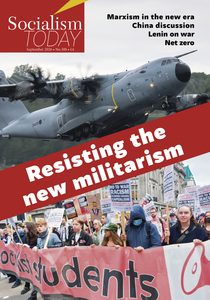
Editorial: Resisting the new militarism plans

A key event in the unwinding of Keir Starmer’s floundering premiership was the resignation, on June 11, of the previously ultra-loyalist John Healey as defence secretary. Coming on the eve of the Makerfield by-election which saw Andy Burnham return to Westminster, and just weeks before a NATO summit to re-commit its member states to a 5% of gross domestic product (GDP) military-related spending target by 2035, it was a coup de grâce moment.

Healey departed, complaining that the Starmer government’s proposed defence investment plan “falls well short of what is required for defence and the country at this dangerous time” and that he could not, therefore, present it to parliament. The investment plan was meant to deliver the recommendations of the Labour government’s 2025 Strategic Defence Review, which argued for a transformation of the UK’s armed forces. From a military still shaped by the tasks “of the post-Cold War era” – for “conflicts primarily fought against non-state actors on Europe’s periphery and beyond” – and not for the new era begun by Russia’s “inflection point” invasion of Ukraine in 2022, “with state-on-state war” back on the agenda. But the investment plan only proposed a 2.7% of GDP spend by 2030 harrumphed Healey, “the date when NATO has warned we could face a Russian attack”. (The Guardian, 1 July)

Read more

‘Net zero’ is a trade union issue

In Britain and beyond, the summer of 2026 has been marked by record temperatures, deadly wildfires and drought, the inevitable consequences of climate change driven by the burning of fossil fuels.

The UK Met Office reported that “daytime maximum temperatures across England and Wales are now roughly 3-4°C hotter than they would have been without human-induced climate change”, adding that “more than 2,700 people are thought to have died from heat-related causes during the May and June heatwaves in England and Wales”.Those figures will have been added to further by the ongoing high temperatures in July and August.

Read more

Global Warning: The environmental record of Greens in power

Across Western Europe the alarming impact of global warming has been acutely felt this summer. Record temperatures contributed to thousands of heat-linked deaths; drought has been disastrous for agriculture; wildfires brought loss and fear. This is while no part of the globe escapes from extreme weather events, often severe enough to dominate media headlines.

The political parties that claim to prioritise the fight against climate change are those calling themselves Green or ecology parties, and it isn’t surprising that many of them have at times increased their electoral support and membership on the basis of hopes that they are indeed the most environmentally friendly option to choose.

Read more

Our theoretical tasks

This June the CWI produced a new book, The Revolutionary International, which includes an updated programme alongside a central text, the Historical Struggle for a Revolutionary Socialist International and the Programmatic Foundation of the CWI. This article by HANNAH SELL is based on an introduction and reply to a regional Socialist Party meeting initiating the discussion on the book, which we are publishing in our three hundredth edition as it summarises some of its key themes, focusing particularly on the theoretical tasks facing Marxists in Britain today.

We are discussing a new document about our international programme historically and today, but what do we mean by a programme? We are talking about more than just a list of demands. This is a discussion on our central conclusions about society and the struggle to change it which enables us to draw up that list of demands, our “common understanding” as Leon Trotsky, leader of the Russian revolution alongside Lenin, put it in the article from 1938, which is included as an appendix to the CWI book. “What is the party? In what does the cohesion exist? This cohesion is a common understanding of the events, of the tasks, and this common understanding – that is the programme of the party”.

Read more

Lenin and the first world war

Vladimir Lenin, the co-leader of the 1917 Russian revolution, took a clear, principled class position at the outset of the first world war. But he also related his programme to the developing consciousness of the working class and its different layers, a vital task in this new era of militarism too. PETER TAAFFE explored this theme in an article reprinted here in shortened form from the special world war one anniversary edition of Socialism Today, No.180, July-August 2014.

All genuine socialist internationalists condemned the war. They also denounced in the most vitriolic terms the right-wing leaders of the Second (‘Socialist’) International, who lined up behind their own governments and capitalists to justify the war, condemning the working class to its slaughter and suffering. Karl Kautsky, up to this time, was recognised as the ‘pope’ of international socialism due to his great political authority. But he and other traitors to socialism were condemned by Lenin, Trotsky and other revolutionaries as ‘social chauvinists’: socialist in words but sell-out nationalists in practice.

Read more

China, the duck-billed platypus

In the next article in the series discussing the character of the Chinese state and its economy, launched in the previous edition of Socialism Today, we carry an edited version of a speech by TONY SAUNOIS, the general secretary of the Committee for a Workers’ International, at the CWI summer school, held in Berlin from 30 July to 3 August. A fuller version is available at socialistworld.net

China has emerged as a world power challenging the dominance of US imperialism. It now plays a central role in the world economy and in geo-political world relations, not least in Europe, Asia, Africa and Latin America. It is impossible to analyse world events today or grasp possible future events without considering developments in China. US imperialism has been in a drawn-out decline for decades. Its decline is relative. It remains the largest and most powerful imperial power with economic growth better than many other capitalist countries. Yet the historic trend is clear. It will develop further in the future albeit in quite a protracted manner.

Read more