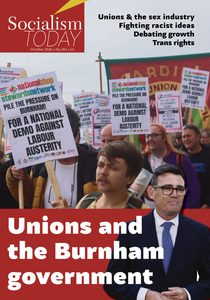
The unions and the Burnham government

How are the union leaders responding to the Burnham government? What is the potential for strike action? And how can a fighting union leadership be built? asks PAULA MITCHELL.

As we go to press, there is the possibility that this autumn three trade unions will be conducting ballots for national strike action – the civil service union PCS, teachers in the National Education Union (NEU) in schools, and further education lecturers in the University and College Union (UCU). Well over half a million public sector workers could be involved in winter strikes. This would be significant at any time – but what’s really significant is that this is just three months into Andy Burnham’s premiership.

Read more →

The challenge facing France Insoumise

France is headed into a major political opening for the working class and youth. The battle for the April 2027 presidential election is underway.

After ten years as ‘president of the bosses’ attacking living standards, term limits bar Emmanuel Macron from standing again. For now, the capitalist class has no viable successor among the fragments of France’s traditional parties – the result of their hated austerity regimes. Jean-Luc Mélenchon and his anti-austerity formation, La France Insoumise (LFI), are placed to contend for an historic victory. So is Marine Le Pen of the right-populist National Rally (RN).

Read more →

Unions and the fight against racist ideas

The emergence this summer of the ‘Patriotic Platform’ against the background of renewed protests against asylum-seekers poses again whether the approach of the SWP and the Stand Up To Racism campaign is effective in curbing the growth of the far-right. ISAI MARIJERLA writes.

This spring, in an article entitled ‘Why the CWU union leadership is wrong over anti-racist strategy’, the Socialist Workers’ Party (SWP) dealt with what they described as “sharp debates” on the issue at the Communication Workers’ Union (CWU) conference (Socialist Worker, 15 May 2026). The issues raised are part of an ongoing and crucial discussion across the trade union movement on how to successfully cut across the growth of right populism.

Read more →

Trade unions and the sex industry

A number of resolutions were submitted to trade union conferences this year calling, amongst other things, for the full decriminalisation of sex work. The following article, based on a recent speech by CHRISTINE THOMAS to a meeting of women members of the Socialist Party, is published here as an initial contribution to a discussion about the issues raised in the conference motions.

It’s important to say from the outset that the sex industry(1) is a very broad spectrum ranging from the horrific forced trafficking of women(2) for prostitution at one end to sex chat lines and OnlyFans at the other. Because of this it’s not possible to have a catch-all position that is relevant for every aspect and each issue needs to be discussed concretely.

Read more →

Birkenhead 1932: Unemployed workers’ fight for justice

At a time when young people in particular are facing a growing jobs crisis, LINDA TAAFFE recounts an inspirational struggle of the unemployed in Birkenhead at the time of the Great Depression of the 1930s.

Idle Hands, Clenched Fists: The Depression in a Shipyard Town

By Stephen F Kelly

Published by Spokesman Books, 1987, £6.95

A million young people aged 16-24 years are currently unemployed. This includes the unskilled as well as graduates – even doctors! What an outrage. They are the first generation to be worse off than the one before. To allow a million of our youth to languish in a state of joblessness, of not being able to pay a rent, or not enough money in their pockets to go out for the night socially, let alone not be able to use the skills they might have studied at university, is a total condemnation of this rotten capitalist system. Things can’t go on like this. Despite all the tactics used by the bosses’ class to keep the young distracted through football, and other sports events, celebrity gigs and all kinds of digital media platforms, our history tells us that at some point the pot will boil over. The pressure cooker will explode.

Read more →

Debating ‘degrowth communism’

Is ‘degrowth communism’ the only answer to the environmental crisis? Did Marx himself abandon the idea that capitalism develops its own ‘grave-digger’, a working class capable of transforming society on a sustainable socialist basis? PETE DICKENSON writes.

Slowdown: How Degrowth Communism Can Save The Earth

By Kohei Saito

Published by Weidenfeld and Nicholson, 2025, £10-99

Marx in the Anthropocene: Towards the Idea of Degrowth Communism

By Kohei Saito

Published by Cambridge University Press, 2023, £30

‘Eco-Marxist’ academic, Kohei Saito, has generated a debate on the eco-left in recent times with his claim that Karl Marx in his later years abandoned his theory of historical materialism and instead became an advocate of ‘degrowth communism’. Degrowth or cuts in consumption are accepted as necessary for sustainability by many eco-socialists, and by most eco-economists, ecologists and environmentalists, including well known figures such as Greta Thunberg in her The Climate Book. Two of Saito’s books in particular, Marx in the Anthropocene and Slow Down: How Degrowth Communism Can Save The Earth, sum up his position. The first written from an ‘academic’ perspective and the second a popularised approach to the subject, that sold half a million copies in Japan alone and was widely reviewed in the West.

Read more →

A socialist approach to the National Question

MARTIN POWELL-DAVIES reviews the latest volume in a series of books published by Mentmore Press bringing together some of the many articles written by the late Peter Taaffe.

The National Question: And Its Part In The Fight For Socialism

By Peter Taaffe

Published by Mentmore Press, 2026, £14.99

Peter Taaffe devoted his life to the struggle to build a socialist world, as editor of the Militant newspaper, then as general secretary of the Socialist Party in England and Wales, as well as through being a leading member of the Committee for a Workers’ International (CWI).

As a Marxist, Peter had full confidence in the will and ability of the working class to struggle for a socialist future. However, he also understood that struggle alone is not enough to guarantee victory. It also needs a leadership that has learned from the past and is able to apply the method of Marxism to work out a correct programme, strategy and tactics.

Read more →