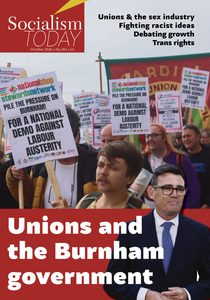
How are the union leaders responding to the Burnham government? What is the potential for strike action? And how can a fighting union leadership be built? asks PAULA MITCHELL.
As we go to press, there is the possibility that this autumn three trade unions will be conducting ballots for national strike action – the civil service union PCS, teachers in the National Education Union (NEU) in schools, and further education lecturers in the University and College Union (UCU). Well over half a million public sector workers could be involved in winter strikes. This would be significant at any time – but what’s really significant is that this is just three months into Andy Burnham’s premiership.
The caveat ‘as we go to press’ is necessary because there is nothing automatic about this development. There is in fact a wrestling match taking place at the top of each of those unions, with decisions being made, and wriggled out of, day by day and week by week. In a sign of the rapidly changing situation, by the time this article is published, the prospects for ballots could have changed.
The Socialist Party has described two trends in the trade union movement. One trend is that of the leaders who are bending over backwards to ‘give Burnham time’.
In each of the unions now preparing to ballot, there has been large amounts of strike action since the election of Keir Starmer’s Labour government in July 2024 – but not on a national basis. In PCS, there has been action in a whole number of departments, including of outsourced workers. In the NEU, the ‘lighting fires’ strategy of the national leadership has seen action in a big number of schools. UCU members have also taken action all over the country, most particularly in universities facing hundreds of job losses, course closures and even campus closures.
These have been necessary because of the immense funding gap in education and the civil service which has only intensified under Labour, felt in the growing workload, low pay, redundancies and closures. But in each case there has been no attempt by the leaderships to coordinate these multiple disputes, or to take the national action so patently required. While Socialist Party members elected to executive committees argued the necessity of a national fight, the leaders used their authority from the 2022-23 strike wave, which was a critical factor in the downfall of the Tories, to hold back national action under Starmer’s Labour government.
Andy Burnham’s premiership, with his promises of an ‘end of 40 years of neo-liberalism’ and ‘action on the cost of living’, has been grasped by leaders who can see no way forward other than trying to persuade workers that, yes, the Labour government is not doing everything we want, but at least it’s better than the Tories or Reform.
In the run up to September’s Congress of the TUC, the press talked of a new ‘cosy relationship’ since Burnham took office. The TUC website says things like: “The winds of change are blowing in the right direction, but there’s still a lot more to do”.
In his keynote speech, TUC general secretary Paul Nowak was determined to put a positive gloss on the Labour government, listing all the “achievements” of the last two years. Principally, these concerned the Employment Rights Act. Astonishingly, Nowak declared “Anti-union legislation – repealed”, despite the fact that the Tory 50% turnout threshold in industrial action ballots is still in place more than two years after the general election pledge to repeal it. He appealed to delegates to “take the prime minister at his word and work with him” and “to politicians and employers – work with us”, an explicit repeat of the partnership approach called for by Starmer when he first took office.
Workers can’t wait
Nowak was not alone in trying to give Burnham a helping hand. Not one of the general secretaries of the unions preparing for ballots mentioned that fact at the TUC. As the TUC closed, NEU general secretary Daniel Kebede made an announcement from the Brighton seafront that an extra £500 million had been won to fund teachers’ pay, and that this is ‘a government we can work with’. The reality of this claim and what it means for the NEU ballot is subject to urgent debate in the NEU as we go to press, but signals Kebede’s desire to stave off action against Burnham’s government.
But on the other side are the members and the wider working class, who cannot wait. While many workers are hoping against hope that Burnham will be better than Starmer, reflected in the slight improvement for Labour in the polls, the reality of the cost of living and the cumulative effect of years of austerity and privatisation in all public services, including council services, the NHS and housing, is driving workers to join trade unions and press for action, no matter what ‘breathing space’ crumbs may be dropped. Nowak proudly announced the biggest increase in trade union membership in decades, up by 192,000. That isn’t because workers want the unions to do nothing!
And so in each of the three unions with agreements to ballot, there is a battle back and forth, with the pressure of members and the objective needs of the situation articulated by socialists, particularly Socialist Party members and their allies, at national executive levels of those unions, against leaders who have opposed, ignored, and attempted to overturn the democratic decisions repeatedly made at conferences and by the elected lay members that make up the executive committees.
The details of these battles can be read in the pages of the Socialist newspaper every week. In PCS, a left-majority National Executive Committee (NEC) was elected in May, with Socialist Party members playing a key role in the Broad Left Network, alongside others; but the general secretary Fran Heathcote and those around her are part of the misnamed ‘Left Unity’ grouping which has been attempting to hold back national action. The leading NEU Left grouping, which includes the Socialist Workers Party (SWP), is split on this issue and unable to offer any lead, while the Socialist Party members on the executive, along with their allies, are applying the pressure of the members on Daniel Kebede, NEU general secretary. Socialist Party members on the Further Education Committee of UCU are fighting, with others, for what is necessary against supporters of the general secretary Jo Grady.
This back and forth is a reflection of the anger burning below. The outcomes are not pre-determined, but the daily battle is essential. Whatever happens this autumn, clearly leaders can be pushed to go further than they want to, particularly when that anger has an organised expression in the union. This points to the necessity to build genuine democratic lefts in the unions, that could enable members to organise for the necessary policies at every level, including standing for election, with steps beginning in some unions.
Building workers’ confidence
Unison is not part of the autumn developments. A national ballot was not even proposed in the NHS, despite, on paper, opposition to the pay award. There has been a lot of local action in the NHS, particularly over re-banding, but there is a complete refusal of the right-wing dominated health Service Group Executive (SGE) to embark on national action. The local government SGE, however, is left-led with a Time For Real Change (TFRC) majority. It is the separately elected NJC that actually makes the decisions about strike action in Unison, and that is not currently a left body. Nonetheless, the TFRC-led SGE should have pressured the NJC (National Joint Council) to run a bold campaign, including to demand of the new prime minister that the pay negotiations were reopened, and for funding.
If the ballots in PCS, NEU and UCU go ahead successfully this autumn then that can increase the confidence of members and redouble the pressure inside unions like Unison. The action by resident doctors in the BMA already has had an inspiring effect on other NHS workers, and this would be increased by wider and coordinated public sector action.
In June 2011, for example, at the start of the ConDem government’s savage austerity programme, the same unions (PCS, UCU, and the NUT and ATL, which went on to merge to form the NEU) took coordinated strike action and called a strike-day demonstration in London. That was a precursor to the two million-strong public sector strike in November 2011. The then-left leadership of PCS was able to play a leading role at that stage.
That is the significance of the PCS motion 34 to TUC Congress, calling for coordinated action, and for a trade union-led demonstration this autumn against Labour austerity and for pro-worker policies. While other TUC motions contained demands that workers would agree with, including calls for insourcing jobs back into the public sector and to tax the banks, the PCS motion was the only one that proposed action to fight for those demands.
The TUC leaders, feeling the pressure for movement from below, knew they could not oppose this motion. Instead, they supported it with caveats – that coordination is down to the unions concerned, and that the General Council will decide what it can do about a demonstration depending on ‘resources’.
Given that last year they also agreed to organise a demonstration and didn’t, fighting trade unionists and the National Shop Stewards Network (NSSN) will have to keep the pressure on. That includes campaigning for the unions that are looking at action to form a ‘coalition of the willing’, appealing to others to join them, to press that demand at the General Council meeting on 21 October, and to prepare to strike and demonstrate together.
A united approach like that is essential to maximise workers’ ability to fight – rather than divisions and inter-union rivalries of the sort that have, for example, erupted around the issue of which unions organise school support staff.
Fighting leadership needed
Getting more fighting leaderships elected is part of this process too. Sharon Graham was re-elected general secretary of Unite, just months after a broad ‘Workers Unite’ slate, including Socialist Party members, won a majority on Unite’s Executive Council. Sharon’s industrial militancy and willingness to take on Labour employers – most notably in the Birmingham bin strike – defeated those in the union, organised in the misnamed United Left, who wanted to take the union back to a more Labour-compliant position.
The election of a left majority on the PCS NEC at the same time, with Socialist Party members playing a key role, is important. These elections do not finish the battle that is needed over what is to be done, but they do open up the potential.
In this context, the NEC elections in Unison next year are important too. The NEC has a narrow right majority but, in an indication of the mood of members, a left general secretary, Andrea Egan, part of the TFRC group, was elected last year against right-wing incumbent Christina McAnea. If the left puts forward a fighting programme and wins next spring’s NEC elections (Socialist Party members will be standing alongside TFRC) that will add to the potential for a serious struggle.
Because even if the union leaders do succeed in continuing to hold back struggle at this stage, this is only the beginning. If action is called off it could lead to frustration and disorientation temporarily. But if action is called off with the perception of winning even a small concession, that could boost confidence. That workers are willing to take action this soon into a Burnham government speaks volumes about the reality that belies the fine words, and that will only increase with experience of Burnham in power.
The budget on 28 October is one key moment, with a need to find £10-15 billion just to keep up with surging borrowing costs and inflation. The pressure from big business is mounting to end the pensions triple lock and to resist increasing taxes on the richest – ‘broad’ tax increases, ie on working- and middle-class people are, unsurprisingly, preferred by big business.
While some concessions are possible, especially if forced through the pressure of action, the presentation of the teachers’ pay rise as fully funded, when in reality it is through the use of largely already-allocated savings from the Local Government Pension Scheme revaluation rather than new money, is an indication of Burnham’s priorities. He is determined to show that he is a safe pair of hands – already, in fact, ‘in hock to the bond markets’.
But the budget won’t be the end of it. The bosses want to use the limited ‘Burnham bounce’ to push through more austerity. Public spending is at 45% of gross domestic product (GDP) this year; government debt is at 94% of GDP and gilt yields (the government’s borrowing costs) are at a 30-year high.
It would take socialist policies of nationalisation and democratic workers control and management, a socialist plan, to ensure a decent standard of living, pay, jobs and homes, and quality public services for all. The depth of the crisis of British capitalism means that any government that attempts to rule in its interests will become hated. A stable basis of support is impossible for a party continuing austerity.
Workers need a political voice
The current developments are an indicator that the ability of the union leaders to hold back action cannot go on permanently. But neither can action remain on the industrial field alone.
The TUC, in response to the £72 million crypto-billionaire donations to Reform and the masked far-right marches in Dover and Portsmouth, was full of words attacking “nasty politics” and “the thread that links Nigel Farage, Rupert Lowe, and Tommy Robinson, with Donald Trump, MAGA and the US white supremacist movement”. “That is not the sort of Britain that decent, fair-minded people want to live in”, said Nowak – in just one line, dividing workers, including trade union members, into those who are ‘decent’ and those who are not, without any attempt to explain why many are currently thinking of voting Reform.
The basis for Faragism has been laid by decades of attacks on the working class. Socialist Party members have fought vigorously for trade unions to take the lead against Reform and the far right, not just with denunciation, but with action for demands that recognise the despair and anger that so many feel and can bring workers together – for jobs, services, pay, homes, a programme of socialist demands (see page 11). This is important, not least because the capitalists and Burnham’s government will step up efforts to sow division – against migrants, but also against disabled people in order to justify benefit cuts, and setting young against older people in order to break the pensions triple lock.
Of the crypto-billionaire donations, Paul Nowak declared: “This is a crisis for our democracy. We cannot allow our political system to be captured by corporate interests”.
Farage, aided by the capitalist media, defended the £72 million by pointing to trade union donations to Labour. Setting aside the reality of scale – over six years to 2025, the income of the Labour Party was £328.7 million, of which just £33.7 million was from union affiliations – Nowak made the correct point that there is no “similarity between care workers chipping in a few quid a year through their union and a party bought and paid for by billionaires”. Interviewed on Radio 4’s Today programme, Sharon Graham added that union demands are made on the basis of open democratic discussion, whereas the intentions of these billionaires are completely hidden.
But the main point is that this is not a ‘corporate takeover’. The only difference here from normal practice in capitalist democracy is one of degree. All the main parties aim to operate in the interests of big business and take substantial donations from individual corporations. The answer is not to continually appeal to a pro-capitalist Labour government to deliver, but to fight for a genuine workers’ political voice with a socialist programme that could offer a real alternative for working-class people desperate for change. The need for the trade unions to discuss how to achieve that has not diminished, it is ever more urgent.
The near-unanimous vote at Unite’s 2025 policy conference to open up a debate about its relationship with Labour – an emergency motion written by Socialist Party members and allies in response to the treatment of the Birmingham bin workers by a union-busting Labour council using fire and rehire to impose £8,000 pay cuts – must now be implemented. PCS also now has conference policy for a trade union conference to debate political representation.
Under Andy Burnham’s premiership the ground is churning. The battle is on in the trade unions, with Socialist Party members playing an important role, to mount a serious industrial fight and build a working-class political alternative.